PIFRA Position Code
Let’s be brutally honest. If you are a government employee in Pakistan and your salary suddenly stops hitting your bank account, the problem is rarely a nationwide budget crisis. In 2026, 90% of unexplained payroll suspensions come down to a single clerical error: a mismatched PIFRA position code.
Most employees do not even know this code exists until their pay is frozen. They assume their personal employee number is the only thing that matters. That is a terrible assumption. The Accountant General Pakistan Revenues (AGPR) database does not just track who you are; it tracks the exact physical “seat” you occupy.
If your Accounts Office fails to properly update your ddo position code on the master digital ledger, the system automatically assumes your job is vacant. No code means no pay. It is that simple.
In this comprehensive 2026 guide, we are decoding the backend of the Piffra (officially pifra) network. You will learn exactly how to locate your code, how to verify if your post is marked as a DDO BER open filled post, and how to force your department to fix the errors holding back your cash.
What Is a PIFRA Position Code?
To understand how the government manages its massive workforce, you have to look at the DDO Ber Position Code Framework.
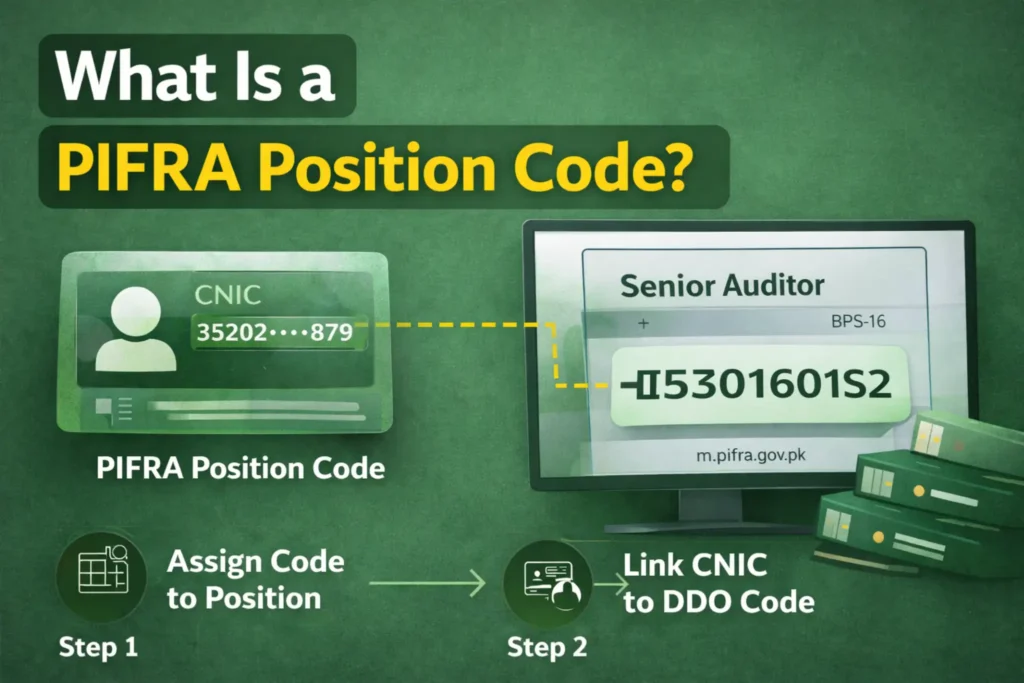
A position code is a unique, alphanumeric string assigned to every single approved job slot within a government department. It has nothing to do with your name or identity. Instead, it represents the physical vacancy. For example, a “Senior Auditor BPS-16” desk has a specific code tied to a specific budget line item.
When you are hired or transferred, your local Drawing and Disbursing Officer (DDO) must link your personal CNIC to that specific ddo code PIFRA. This action tells the m.pifra.gov.pk master server that a human being has officially occupied the funded seat.
Benefits of Using the Position Code
Why does the government make this so complicated? Because before this system, departments were overrun with “ghost employees” drawing salaries for jobs that did not exist.
Here is why the ddo position code pifra is actually your best friend:
How to Locate Your Position Code
What usually trips people up is trying to find this code on public websites. You will not find your specific code floating on the internet for security reasons.
Here is exactly how to find it:
- Check Your Pay Slip: Look at your latest pifra salary slip. Your specific ddo codes and position identifier are usually printed near the top-right corner beneath your basic pay scale details.
- Consult Your DDO: Ask your local accounts clerk to pull the pifra ddo code list from the master ddober (Budget Execution Report) file.
- Provincial Variations: If you work in Khyber Pakhtunkhwa, your HR department maintains a specific position code kpk (or ddo position code kpk) database. You must request this directly from the provincial m.pifra.gov.pk position code internal portal.
Position Code vs Employee Code
- Do not confuse these two terms.
- Your Employee Code (Personal Number) belongs to you. It stays with you from the day you join the government until the day you retire, regardless of where you work.
Your pifra position code belongs to the department. If you get promoted or transferred, you leave your old position code behind for the next person, and you inherit a brand new one.
How the Position Code Streamlines Payroll and Budgeting
- Behind the scenes, the pifra ddo ber system is an absolute machine.
- When your department needs to pay salaries, they run a budget check pifra. The system scans the pifra ddo monthly expenditure against the ddo budget pifra. It specifically looks at the ddo filled and vacant posts ledger.
- If the system sees 50 funded position codes, but 55 employees are trying to claim salaries under that specific ddo, the pifra bill status will immediately flag an error. This strict online budget check ensures departments cannot illegally over-hire staff without prior finance ministry approval.
Common Errors in Position Codes and How to Fix Them
How to Register with PIFRA for Payroll Information
- To monitor your salary and ensure your code is active, you must set up your pifra salary slip registration immediately.
- Navigate to the secure www pifra gov pk portal (often linked via www.pifra.gov.pk pay slip registration). You will need your CNIC, Date of Birth, and your exact Government Code. You do not need to input your pifra ddo code here; the system automatically retrieves your ddo bar data based on your CNIC.
- Once registered, you can execute a pifra pay slip download every month straight from your email inbox.
Keeping Your Employment Records Updated
In practice, your employment data degrades over time if nobody audits it.
Every fiscal year, your department pulls historical reports like the ddo ber 2023-24 and the new ddo ber 2024 to conduct a massive pifra ddo budget check. If your HR department does not reconcile the ddo open slots with the physical staff present, discrepancies will trigger audit objections.
Ensure your clerk regularly reviews the pifra open and filled post report. If you recently transferred, demand that they verify your new ddo position code on the m pifra ddo dashboard before the 25th of the month.
Digital Transformation Through the PIFRA System
The evolution of the m.pifra.gov.pk ddo platform has completely eliminated paper-based fraud.
From managing a pifra ddo expenditure to maintaining complex PIFRA Vendor Information for private contractors, the digital ledger is absolute. Even if users accidentally misspell the portal URL as m.pifra.gov.ddo, ddo ber pifra, or m.pifra, the backend routing remains strictly secured by the State Bank API. This transformation ensures that every ddo budget check is backed by real-time treasury data, not outdated manual entries.
Editor’s Analysis: My Verdict on the PIFRA Position Code Framework
With over 30 years of analyzing government financial systems and digital infrastructure, I have seen exactly where the AGPR framework succeeds and where it violently fails the average worker.
My Verdict? The pifra platform is structurally brilliant, but it relies entirely on the competence of underpaid local clerks.
The system treats a position code as undeniable law. It does not care if you have been showing up to the office for 30 days straight. If the digital ddo ber ledger says your post is “Open,” you do not exist financially. Period.
What usually trips people up is misplaced trust. Employees trust their DDOs to handle backend data entry automatically. That is a fatal financial mistake. I have seen thousands of salaries suspended purely because a clerk ran a pifra ddo budget 2021 or 2024 update and forgot to hit “Save” on an employee’s transfer code.
You must be aggressive about your data. Every time you get promoted, every time you transfer, and at the start of every new fiscal year, demand verbal or written confirmation that your position code is accurately synced to the ddo budget. Protect your cash flow by treating your position code like a bank PIN.
Advanced FAQ Section
Conclusion
Your pifra position code is the most important string of numbers in your government career. If it is inaccurate, your money simply will not move.
By understanding how the ddo open and filled ledgers work, you stop being a passive victim of bureaucratic errors.
Your Immediate Next Steps:
- Check your latest pifra salary slip and write down your 6-digit position identifier.
- If your pay is delayed, immediately ask your clerk to verify the ddo open and filled post kpk (or your respective province) report.
- Never assume an IT system will fix itself. Force your DDO to manually verify that your seat is marked “Filled” on the master pifra gov pk budget sheet today.